NYC's Newest Fashion Titan: Fish Fiorucci and Queer Representation on the Runway
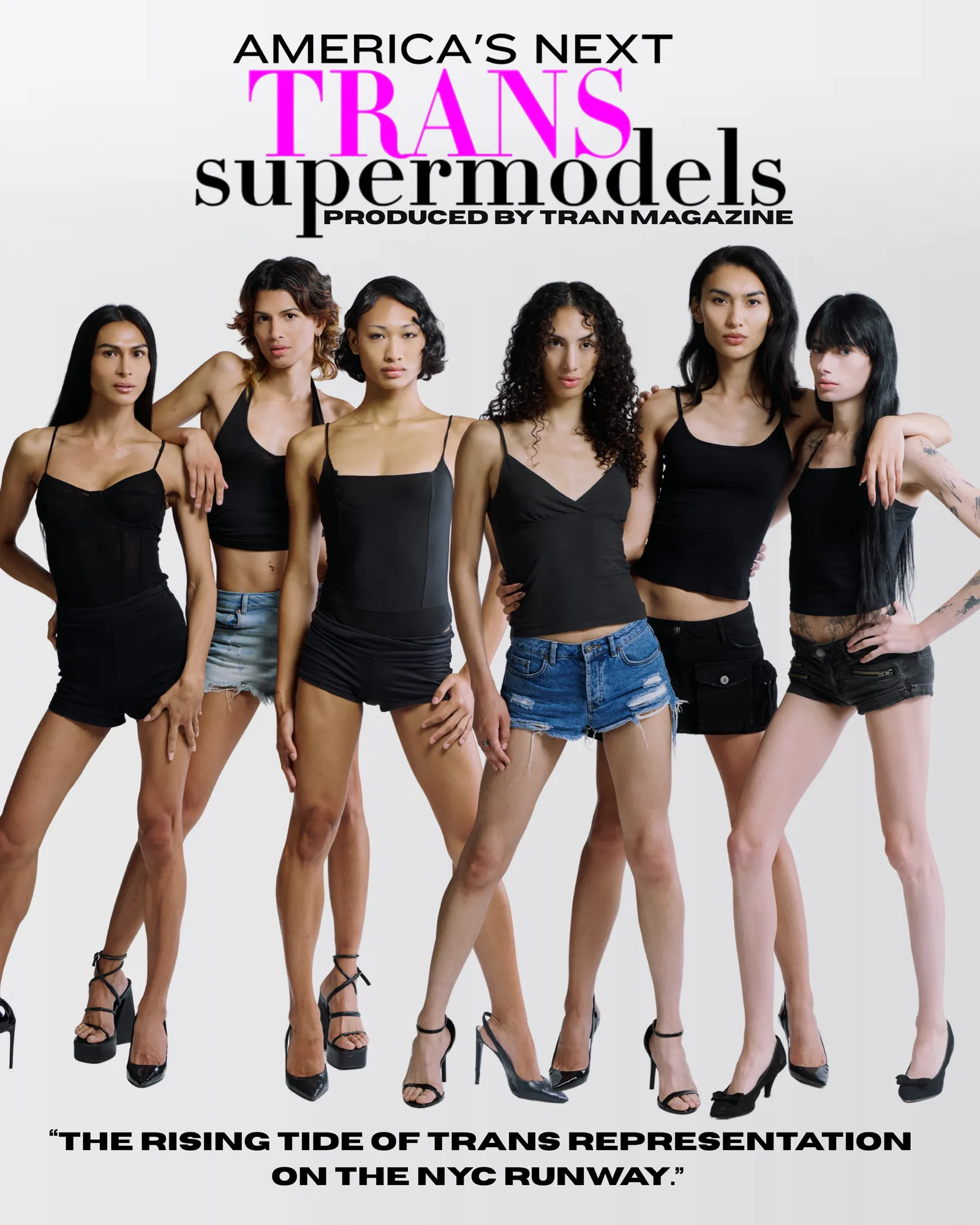
FISH is the founder of F10 Casting, a non-binary runway model, and a creative director based in New York City. We sat down for an in-depth conversation about NYC casting, representation, fashion, gender, and creating opportunities in anindustry that doesn’t always make space for you.
TRAN MAG: Today, you are working as a casting director and the founder of F10 Casting. You work with designers on the CFDA calendar, team-style artists such as FKA twigs and Lady Gaga, and run castings for new artists such as Sosi, while working alongside creatives like Joaquin Castillo. You’re doing all of this in oneof the world’s major fashion capitals.
On top of that, you do this as an openly non-binary, queer creative who advocates for TGNC and BIPOC representation through your work. So, my first question is: What has been the highlight of your career in casting thus far?
FISH: Ooh, that’s a good question.
My biggest highlight in casting, believe it or not, started in Texas. When I firstlaunched my casting agency, I was seeking funding through multiple investors—angel investors, big businesses, just people with a lot of fucking money.
And we’re talking about Texas. We’re talking Elon Musk territory.
I did this interview with Texas Monthly, and at the end of the interview, I shaded SpaceX and Elon Musk. Shortly after that interview came out, they emailed me to come in for an interview to start doing in-house casting for SpaceX events.
And I was so fucking confused. I was like, “What the hell is this?” Like, this is literally human trafficking right here. They wanted pretty people walking around SpaceX. That’s what they wanted, really.
But through that, they introduced me to a lot of other wealthy people in Texas. And I’m coming from a poor city in America, right? So when I hear about rich people in my hometown, I’m like, “Where? That’s so taboo. Where the fuck arethe rich people? Point them my way!”
Back then, if somebody had a three-story house with a basement, I’d think, “That’snice.” We’re talking about an era when Elon Musk was married to Grimes.
So I was like, “Okay, you know what? You’re a pretty woman. I don’t care what y’all wantfrom me, but what I want from y’all is for you to introduce me to all the rich people.”
And they did.
I was given a $20,000 check to open up my casting agency and promote tourism, promote people making it out of the Valley, and promote people making it out of Texas. I’m from a small hometown, and I’m doing big things. That was the narrative they wanted, and they were giving me $20,000 to do that.
So that was probably my biggest highlight. It was probably the moment in my casting career when I thought, “Okay, if I can get $20,000 from somebody inTexas, you better believe I’m going to keep planning this money.”
So, yeah. I got my $20,000.
TRAN MAG: Second question: Why do you think the industry is so behind when it comes to TGNC representation, specifically representation for trans models of color?
FISH: Well, right off the top of my head, I can tell you that a lot of the industryis scared of representing our community because the clients aren’t prepared to dress these people in a way that makes them feel confident enough to walk out of that dressing room.
You go into a casting as a trans person and you instantly get misgendered. You get asked to put on clothes that you don’t even want to wear—stuff that just makes you feel like you’re not your full self, your full body, your full confidence.
And it leads these agencies to just look at the shoes and then look at you like, “What do we give them?”
Exactly. “I’m busted. What shoes do we give them?”
But for some of the other dolls out there—not everyone, because I know some people have size 13 feet—but for some of the other dolls out there, they can’t accommodate big shoes, let alone accommodate the body types that we have to offer.
So, if you’re asking for a design house to be more inclusive and create community, that’s where they need to start: with the basics. With size 15 shoes. Jeffrey Campbell offers extended sizes. There are options.
TRAN MAG: That conversation actually leads to the third question. How has your influence in the casting world shaped the clients you’ve worked with to create more equitable opportunities for TGNC and models of color?
FISH: Well, all my clients know that they’re coming to me for a specific reason. Out of all the casting directors they can go to, they choose me because they know I’m going to send them faces that they wouldn’t typically associate with.
And that’s your value.
That’s always been a priority for me in my company. The first people they’ll ever see on the deck are trans people, POC people, queer people. Then they get the rest of them.
So it’s never like I’m prioritizing the people who already have the advantage in the industry. That’s never been on my agenda.
TRAN MAG: Would you say that the Latinx queer community in Texas helped shape your ideas about representation and diversity?
FISH: I will say that the Latin community in Texas and California has shaped that a little bit more.
When I first started working with brands like Luar and Richonia, they were always casting people from Texas and California. They were always trans, and it justkind of helped them make their mark in the industry from places where people weren’t necessarily looking.
TRAN MAG: And that leads, I think, to the last question on this topic. As you’re navigating the casting world, what steps do you think the industry can take to catch up with how the world sees and perceives trans and gender-nonconforming models—or gender-nonconforming people in general? And what value do you believe we add to the fashion industry that isn’t currently being seen?
FISH: Well, like I mentioned previously, it starts with the client.
If you’re a casting director out there, it’s your job to push these people and these spaces to the forefront. It’s your job to tell them, “This is the face that you need.” Not necessarily what you’re looking for, but what you need.
Those conversations are very important. They’re very hard to have, but I’m not afraid to have those conversations with these people, no matter how much money I have—or don’t have.
TRAN MAG: I’m going to give a little background to the audience so they have some context for all of these conversations.
In previous interviews, you’ve described a bedrock of your casting principles as championing diversity. As you said, that includes representation of models of color and TGNC models of color.
You’ve noted that, as a non-binary model yourself, it’s rare for high fashion toeven take a second glance at casting TGNC people in print or on the runway. Most modeling agencies rarely have boards for non-binary models, and some of the topagencies in New York City have no trans or non-binary models on their boards.
Back in your hometown, you created a fashion show by moving all of your family’s belongings out of the house while they were away. That made Texas news headlines. You created a brand and a portfolio in Texas by creating crazy events and spaces where you wouldn’t typically expect to see fashion shows.
These experiences motivated you to the point that you won a $20,000 grant, which you used to start your own casting business.
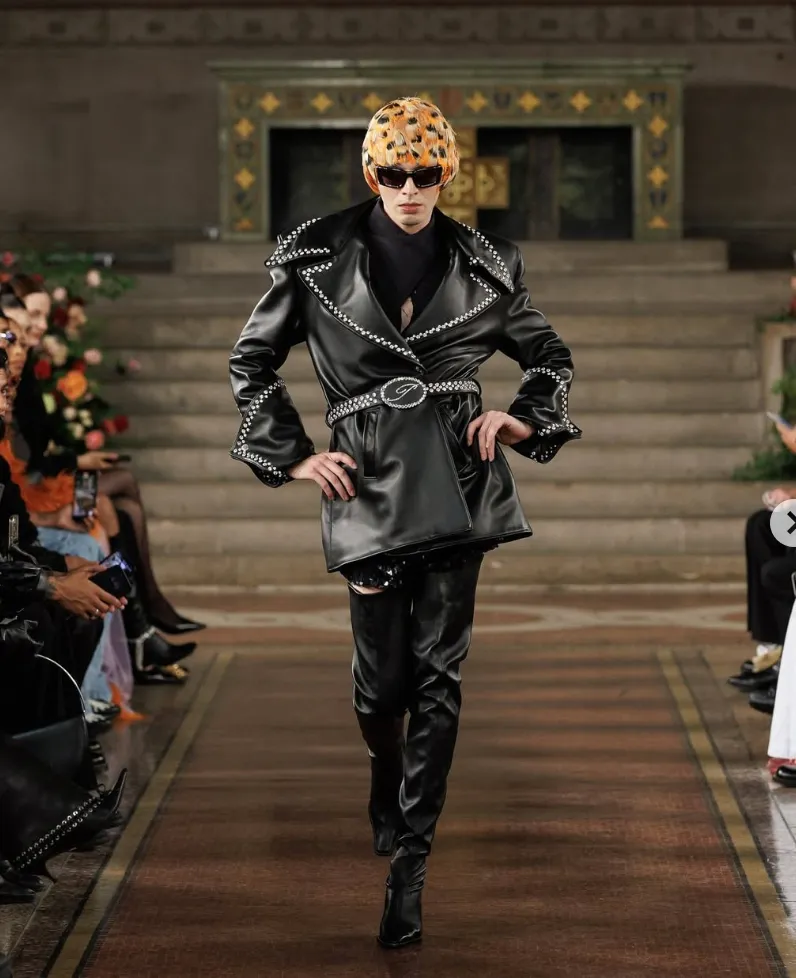
You also found your way into closed castings for shows like Luar, eventually finding a spot on the runway, and most notably made history as one of the first non-binary models to walk for Balenciaga.
You’re a risk-taker. You dream big. You utilize the resources around you through networking, relationship-building, and creating what you didn’t see for yourself—from the Rio Grande Valley to the Big Apple.
To transgender, gender-nonconforming creatives, models, or anyone looking to step into the fashion industry, what is your best advice for creating your own lane and making opportunities happen when no one is willing to offer them to you?
FISH: I should start by saying, in middle school, I was the most popular kid in sixth grade.
Come seventh grade, my balls didn’t drop, and suddenly everybody was like, “You’re fucking gay. We’re not going to hang out with you anymore.”
All these cis men no longer wanted to be my friends. And then these cis straight women didn’t want to defend me against their abusive boyfriends.
So I was like, “You know what? Fuck this shit. Y’all want to be popular in school. I want to be popular outside of school.”
TRAN MAG: Because girls were jealous of you?
FISH: I think we were both—maybe I was a little bit more fashionable.
But I wanted to do something that was outside of my regular everyday schedule at school. We were wearing uniforms and acting like everything was normal, whilepeople would get offended when they called me gay.
And I didn’t do just one production. I did over 80 productions from the time I was 14 or 15 all the way up until I was about 18 years old.
Every birthday I had was shows on shows on shows.
It was always my parents saying, “We don’t want to give you money.”
And I’d say, “I want a fashion show.”
And they’re like, “What the fuck do you mean?”
I’m like, “Give me the money. I’ll find the venue. I’ll cast the models. I’ll find a designer.”
TRAN MAG: Are you a lover and aficionado of Party Monster?
FISH: Oh, of course. I read the book before I saw the movie, though. And I also partied with Michael Alig before he died.
I quote that shit on a daily, honestly.
But this is true: I started with production in Texas, and then as soon as I felt like I had done enough, my mom would always beg me to walk in fashion shows, and I was like, “No. That’s not what I want to do.”
I was focused on production, event coordination, activations. I wasn’t worriedabout modeling.
I was working on things like Toilet Paper, Agassi, and stuff like that.
I remember when I was afraid to shop at The Gap because I was afraid people were going to clock me as gay. I thought, “Oh, Gap is the gay store.”
TRAN MAG: Wait, I’m not done.
FISH: Oh, yeah. Keep going. Keep going. I’m entertained.
TRAN MAG: Sorry.
FISH: So, I kind of always had this narrative in my mind that I was going to be more famous outside of school than I was in school.
And as soon as I turned 17, the first thing I did was come to New York on a school field trip for theater. Meanwhile, everybody else was going to Broadway shows. I’m overhere shooting with some of the most notable photographers in fashion at the time.
I managed to connect with all of them on Instagram at my age.
So when I would return to school, people would be shocked by what I had posted online. I’d be 17, and I could be featured in some of the most high-fashion shoots you could imagine.
I’d come back to school, my Instagram would be filled with the most high-fashionshit you could ever imagine, and my principal would come into the office and be like, “We need to talk.”
TRAN MAG: What first started your interest in fashion?
FISH: My introduction to fashion was through pageants.
I used to coach Miss America, Miss Texas, Miss Brown. That’s how I learned how to walk.
TRAN MAG: I knew it.
FISH: I sensed the Abby Lee Miller energy.
The only way I was going to learn how to walk in heels was by going to theseclasses, where I lied and told them I knew how to teach girls how to walk in heels.
So I couldn’t wear them at home. I had to go to a studio.
TRAN MAG: Every time I see you behind that casting table, looking at the girls, diva, I feel like you’re giving me Abby Lee Miller in the dance studio.
FISH: And then you do that lean-back thing, and you’re like, “This,” and then you go through something and you’re like—
It only started with pageants.
TRAN MAG: Okay. I hope you’re not going to dislike this next question.
In previous articles, you’ve mentioned that your name, Fish, comes from you owning a term people used to bully you with because they said you looked like a fish.
You used that to own your own narrative and also as a way to work through your transition and your gender fluidity. It’s giving Rainbow Fish.
You’ve previously mentioned that you’ve had thoughts about transitioning, but that you love all expressions of gender. Where are you now in your gender, transition, or journey, if—and only if—you’d like to share?
FISH: I am in my Marilyn Manson era, if I can say that without getting too controversial.
TRAN MAG: That’s really fierce.
FISH: I know he’s so problematic.
But it’s the art.
I grew up with my brother listening to music like that. My mom granted my brothers permission to paint their nails, wear their hair crazy, and do all that.
The second I wanted to paint my nails or do something a little bit more permanent, it was, “Are you a girl?”
“No.”
“Then take that off.”
So I’ve always just had this inspiration in the back of my head about what Marilyn Manson represented.
He was very queer about that. I think Marilyn Manson was always queer—very trans—but he was never promoting it as that. And I think that’s why a lot of queer people related to him.
That was the kind of stuff I had access to that helped me grasp an idea of whatfashion could be for me.
So, the second I left middle school and got into high school, I had the opportunity to really become who I wanted to be.
I asked my parents to switch me from a conservative high school district to a less conservative one so I could start dyeing my hair, shaving my eyebrows, wearing heels to school, and changing the student code of conduct to allow women to wear men’s clothing and men to wear women’s clothing.
But again, it always came back to the fashion inspiration that my brothers really pushed on me growing up.
It was always musical.
TRAN MAG: Last question. What designers or projects are you currently working on that you can tell us about or are excited to share over the next couple of months? Anything you want to celebrate?
FISH: I just received a casting request from Gucci.
I got their request yesterday for females, but they put me down for males. SoI’m really excited about that because I come from that Balenciaga world.
When Demna moved over to Gucci, I thought, “They’re going to forget about me.”
And it feels so good knowing that the casting directors have supported the change I’vemade from modeling to casting. The casting directors are now giving me the emails.
TRAN MAG: You’re a presence.
FISH: Exactly.
So I think they know that whatever I was trying to do back when I was a modelreally correlated with what I’m doing as a casting director right now.
TRAN MAG: Well, you also came into New York, saw a gap in the market, and createdsomething that means something to you based on your experience working in modeling.
The first show that you walked for, Balenciaga—was that in their men’s show?
FISH: No. I pushed them to switch me to women’s wear.
We did two shows with Balenciaga, right?
TRAN MAG: Okay, bitch.
FISH: And I don’t mean to throw shade at Balenciaga at all, but the fourth showcame around and they put me in men’s wear, and I was so fucking pissed.
TRAN MAG: They tried everything. Did you ask them?
FISH: No. I mean, I told them I wanted to walk in women’s wear, but I always told them I wanted to wear a heel.
TRAN MAG: Yeah. You’re going to throw me on the runway, you better be in a fucking five-inch-plus heel.
Isn’t it crazy that they don’t just listen to you? Because that’s your identity. Thatis who you are.
FISH: So the fourth show came around, and I remember a couple of models from New York flew over for fittings. All of them had lied on their comp cards abouttheir size—their height, their weight.
I remember being in the rooms next to them, overhearing the dressers saying, “You’re not this size. You’re not this height. We’re going to send you back home to America alone.”
And when you go to a fitting for Balenciaga, you’re probably already committed at that point. For them to get to that point, lie about everything, and then get sent back home after the fitting—that’s what I think happened to me.
Not that I lied about my weight, but I just wasn’t fitting as femininely as some of the other cisgender women were.
So they brought me into menswear.
TRAN MAG: I’m sorry.
FISH: And they put me in a Supreme unreleased collaboration shirt and a Balenciaga outfit, if you could ever imagine, and flat shoes.
Not the flats.
TRAN MAG: If you give me a flat, I’m going to jump off a fucking bridge.
What’s your name from Sex and the City? I can’t wear flats because I have tothink in heels, you know?
FISH: Exactly. There’s something about being in heels that makes you feel more creative.
This was the mud show, and so imagine all the other models walking in heelson Mars. And they weren’t five inches at that time.
I wanted that challenge, and they took it away from me like that.
But it’s okay. I still work with them.
TRAN MAG: Well, to close it out and bring it full circle—because you’ve also said that casting directors, in my opinion, have a different position in the fashion cyclethan models. You’re on another part of that cycle now.
So, the last question: You’ve made your way from a small border town in Texas to the Balenciaga runway to becoming a New York casting director. What else is next in the trajectory of Fish?
FISH: I think what should be differentiated in my career is that, as a casting director, I’m Fish Navarro.
And, again, I love the work that I do, and I’ve always thought about my background.
But Fish is Fish.
When I’m in my element, that’s when I am over the top. That’s when I’m fierce.
I mean, as much as I do that in my everyday life, I’m also aware of the visibility that needs to happen in the community—and just in general in life—for people to understand what trans people are.
If it’s hard to walk out of the house because something feels so unnatural to you,eventually it becomes natural to you.
TRAN MAG: What else is next in the trajectory?
FISH NAVARRO: I think what should be differentiated in my career as a casting director is my background. I’m Fish Navarro, and again, I love the work that I do. I’ve always thought about my background and how it informs the work that I do.
Being visible and being engaged in the community comes with its own fears. When I am out in the world and being visible, I think about what that means—not just for me, but for other people as well.
I mean, as much as I live that in my everyday life, am I able to do the work that I feel needs to happen? I feel like I’m working toward everything I wish for you to do: creating the visibility that needs to happen in the community, or just in general in life, so people can understand what it means to be trans.
If it’s hard to walk out of the house because something feels so unnatural to you, eventually it becomes natural to you. And I think it’s the same thing with how cisgender people think about trans people. It’s like, “That’s not one of us.” Yeah.
So, when I have my moments of visibility, when I step out of the house, I look around and I take it all in. But it comes with that responsibility, too.
TRAN MAG: I don’t want to take up any more of your time. I just wanted to say that you’re a trailblazer. You’re doing a great many things at a very, very young age.
Many people who are very talented and who are in the upper echelon of the industry—and also people who aren’t in the upper echelon, but are fucking brilliant and cool as fuck—have an appreciation for you.
So, when you have tens across the board from both the industry, which is very hard to build relationships in because you’re a trans person, and from people who may view you as having all these things that they don’t, you’re really fighting for everything that you have—for every job, every client, every relationship, and every step forward.
Those are things that you spend hours working on creatively.
FISH NAVARRO: A non-binary board, until I told them to label it as one. Yeah. And then again, I was the only face on it, and then it was gone.
TRAN MAG: And you know what? They have a lot of non-binary boards up, and a lot of the pages look very empty. So that needs to change, too.
FISH NAVARRO: Exactly.
TRAN MAG: But I can get in trouble because, you know, I’m here to look at this from an objective point of view. So, yeah, thank you so much.