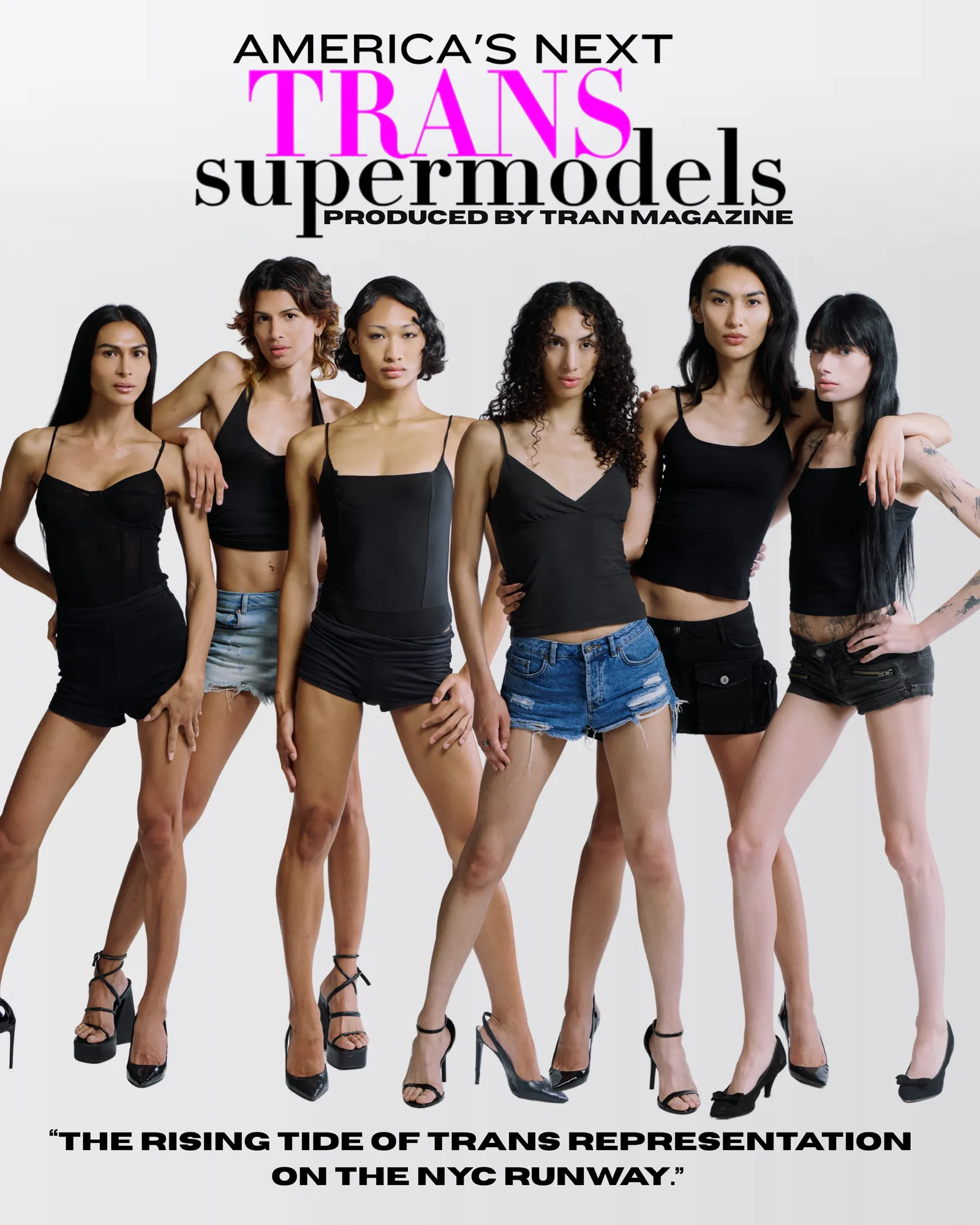
America's Next Trans Supermodel: Who Comes After Alex Consani?
FORWARD: These models represent the rising tide of Trans Representation on the runway in perhaps the most competitive industry for women in the world.
While the political world is turning on tran’s rights and trans people. These women are defying all odds and succeeding walking the runway for the world’s top high-end luxury designer brands in addition to commercial, beauty and television.
While we have seen a rise of trans representation through the likes of @alexconsani @vivllainous and @hunterschafer the call for equal representation and opportunities among black, indigenous and Latinx trans models still has yet to be seen.
We spoke to these icons in bloom on their experiences in the fashion world and what the industry needs to hear on the values of Diversity Equity & Inclusion and their advice to make it in the fashion capital of the world-NYC!
EDITOR IN CHIEF & CREATIVE DIRECTOR Tasi Taimanglo instagram @skinnylegendnyc
This project was really special to me because I have been working my way into the modeling industry for quite sometime now. I moved to NYC pursuing a career as a male model. I sidelined my transition afraid that there wasn’t a place for trans models on the runway.
I identify as both a non-binary person, my gender is presentationally fluid but I also am a trans person too. I identify outside of the two-binary system of gender. I do not identify as a cis-man or my gender assigned at birth. This concept is difficult as a model in the industry because I do not fit into a fixed-box.
After being dropped from my main agency as a male model. I pursued a successful drag career in NYC, I medically transitioned and found my confidence in queer nightlife. I was a nightlife host, iconic door girl and event producer.
I was scouted by a model agent hosting a runway show who encouraged me to get back into modeling but this time on the women’s board as an out and visible trans model.
My first NYFW debut was for the FALL26 season. I was living in a homeless shelter in Brownsville and going to castings in the freezing winter but my resilience paid off. I went to an open casting with over 500+ models and secured a spot walking the @rioworld FALL 26 show.
After I made it into my 1st print publication w/ @slimimag and this season walked for @eilien.world closed for @josh_tafoya_ & @indigenousnyfw!
I am proud to say this project was entirely made up of TGNC models and artists in front of and behind the camera. Our areas of growth was losing the opportunity to lend a mic to the black trans femmes in the modeling industry who were on this project but due to scheduling conflicts could not make the date, next project my first priority will be analyzing how to build better trust, in part that involves investing more in financial compensation and also incorporating trans creatives of color behind the scenes that includes hair styling and makeup artists but with more projects in the future that will be my main area of focus.
Creative Direction:Tasi Taimanglo @skinnylegendnyc
Photography: Oliver Barile @oliver.barile
Makeup: VNYX @vnyx.nyc
Hair: Esme @esmebetances
Photo Assist: Charlie @mydarlingchaya
Are you signed, unsigned looking for representation or a freelance model?
If you are a signed model to an agency, what were the hardest obstacles in visibility and finding representation? How do you idenitify?
With the rise of Hunter Schaefer, the Vivvine and Alex Consani we finally being to see trans representation on the runway, though the beneficiaries of diversity equity and inclusion usually benefits white women first. Why do you think representation for black and indigenous trans and gender non conforming representation has not followed at the same speed, what is your call to action to the modeling industry and fashion world?
In an industry where there is a pretty fixed two-binary system of how models are represented how did you navigate advocating for your presence in the industry and what we’re some issues you faced in overcoming while painting your true authentic self?
What has been your favorite moment in your modeling career thus far,.
For prospective trans and gender non conforming models interested in moving to New York City interested in a career in the industry what are your three biggest tips?
When you are on your way to an agency meet, casting or booked job what are your must-haves or in your bag to prepare for any of those opportunities?
PERLE TOURE
instagram @perletoure
PERLE is a freelance model from Chevy Chase, Maryland and is a fresh face to the industry. Her start has been modeling for alternative NYC fashion brands such as @ben.doctor @iwantmasculina and @cfgny2 which was most recently featured in @dazed @dazedfashion for SS27.
TRAN MAG: Are you signed, unsigned looking for representation or a freelance model?
PEARLE: Currently unsigned model.
TRAN MAG: If you are a signed model to an agency, what were the hardest obstacles in visibility and finding representation? How do you idenitify?
PERLE: am representing the African and Asian Trans girls on the runway. We have always been here and the inspiration, being the living art.
TRAN MAG: With the rise of Hunter Schaefer, the Vivvine and Alex Consani we finally being to see trans representation on the runway, though the beneficiaries of diversity equity and inclusion usually benefits white women first. Why do you think representation for black and indigenous trans and gender non conforming representation has not followed at the same speed, what is your call to action to the modeling industry and fashion world?I will always go where I am appreciated and truly valued. I am lucky that I have found my chosen family within the industry.
PERLE: To perform and model for the CFGNY show, which explored how the Vietnam war was the first war on film. On the ‘Vaguely Asian’ runway, I walked amongst models who are all artists in their own disciplines. To make community with other Asian trans and queer artists was heartwarming.
TRAN MAG: For prospective trans and gender non conforming models interested in moving to New York City interested in a career in the industry what are your three biggest tips?
PERLE: A threaded brow will center your face. Be true to yourself to let your natural light shine through. Trust in your vision. I love a moodboard.
TRAN MAG: When you are on your way to an agency meet, casting or booked job what are your must-haves or in your bag to prepare for any of those opportunities?
PERLE: Flats will keep your heels pristine to change into, as well as a pair of earbuds. With these, you will continue to pump it!
WINTER ABEL
instagram @w1nn_zzzz
WINTER is a freelance NYC runway model from Anderson, South Carolina @balenciaga @rioworld and fresh off the runway this week for @bad_binch_tongtong!
TRAN MAG: Are you signed, unsigned looking for representation or a freelance model?
WINTER: I am an unsigned model.
WINTER: White supremacy. The industry has unfortunately always been this way and they don’t see black and indigenous models as palatable which is completely wrong because most of the models I really adore and look up to are black and indigenous and quite frankly I think they do it a lot better and just have more charisma than the regular nepo baby white model. I think the best way to fix this issue is to continue pushing black and indigenous trans models and constantly booking them and forcing the world to see their talent and art. Showcase them.
TRAN MAG: If you are a signed model to an agency, what were the hardest obstacles in visibility and finding representation? How do you idenitify?
WINTER: When I first started a lot of bookers would ask me, do you want a male or female look? In a way I appreciate the ask but I really held my ground and let people know I am a trans woman model not just an androgynous model.
TRAN MAG: What has been your favorite moment in your modeling career thus far,.
WINTER: My favorite moment has definitely been working with very diverse teams and just making many new friends with similar experiences to me. We are all one at the end of the day.
TRAN MAG: For prospective trans and gender non conforming models interested in moving to New York City interested in a career in the industry what are your three biggest tips?
WINTER: My biggest tips would be to be yourself and stay true to yourself, learn how to take rejection and just know that rejection is redirection, and to never give up because your moment will come as long as you continue fighting for it.
TRAN MAG: When you are on your way to an agency meet, casting or booked job what are your must-haves or in your bag to prepare for any of those opportunities?
WINTER: Must haves are definitely cocoa butter vaseline and a hair brush.
Alexa Saint Von
instagram @alexa_saintvon
ALEXA is a signed NYC runway model from Leander, Texas and has graced the runway for @veejayfloresca @rehabstudiosny and fresh off the runway for @elenacelez!
TRAN MAG: Are you signed, unsigned looking for representation or a freelance model?
ALEXA: am signed with my mother agency, DOT Model Management and seeking representation
TRAN MAG: If you are a signed model to an agency, what were the hardest obstacles in visibility and finding representation? How do you identify?
ALEXA: I identify as a trans woman. Full she/her pronouns. The hardest part about finding representation was feeling seen. Walking into the room and knowing you’re the only trans girl in there is disheartening in an already highly critical industry. I felt like I was being told I had the right look to get signed it just ultimately became about my trans identity as to why I wasn’t getting signed as quickly.
TRAN MAG: With the rise of Hunter Schaefer, the Vivvine and Alex Consani we finally being to see trans representation on the runway, though the beneficiaries of diversity equity and inclusion usually benefits white women first. Why do you think representation for black and indigenous trans and gender non conforming representation has not followed at the same speed, what is your call to action to the modeling industry and fashion world?
ALEXA: My call to action for the world would be to not just protect the dolls, but to fund the dolls! Employ the dolls! Visibility means nothing if we don’t see actual change. I think we’ve seen the rise of the trans model only in white girls, because it’s more palatable to the masses and society. We need more black and indigenous POC models because we exist. We deserve to be celebrated. Growing up we never see ourselves in the magazines we’re supposed to praise. I’d love for the industry to catch up.
TRAN MAG: In an industry where there is a pretty fixed two-binary system of how models are represented how did you navigate advocating for your presence in the industry and what we’re some issues you faced in overcoming while painting your true authentic self?
ALEXA: I feel like I have to advocate for myself every day I wake up. With the industry I get like the hardest thing for me was trying to get casting directors and designers to see me as “a real girl.” It feels hard to advocate and speak up for yourself in the moment because you’re always thinking about your career, but I think it’s very important to feel respected in a work environment. I’ve faced struggles with casting directors many times. I had a director that loved my look, my stats, my walk, and instantly wanted to book me, but once I opened your mouth to speak, I instantly knew they clocked me and the tone shifted quickly. Suddenly the same person asking for my availability, telling me the rate, showing me my dress, was telling me that they’d “let me know.” Getting directors to respect us and not see us as an “other” category I think would go a long way.
TRAN MAG: What has been your favorite moment in your modeling career thus far,.
ALEXA: My favorite moment has been walking for Veejay Floresca this past February fashion week season. She’s the first trans winner of Project Runway. I love that it was important for her to not only cast trans women in her show, but to book more than one and all of us be women of color. It was my first calendar CFDA fashion week show and I can’t think of any better way to experience it. Also getting to walk along the infamous Tracey Norman was so meaningful.
ALEXA My 3 biggest tips would be to 1. Focus on your career/remember why you’re here. Don’t get swept up in the city, nightlife, drinking, drugs, etc. There is community everywhere if you look for it. 2. Build your book. You need to get comfortable being in front of the camera, seeing all angles of your face and body regularly, and have a killer portfolio. Reach out to friends to shoot with, find people on social media. Build your network. 3. Don’t give them any reason to not book you. When you show up to set, you are early, you are not hungover, you are prepared. Our community doesn’t get a lot of opportunities, let’s not lose out because you want to have temporary fun.
TRAN MAG: When you are on your way to an agency meet, casting or booked job what are your must-haves or in your bag to prepare for any of those opportunities?
ALEXA: Heels, comp cards, sunglasses, lotion, and a hair tie.
RAIN
instagram @rainbatingana
RAIN is currently a model on the current season of @projectrunway Season 22. She has an extensive modeling portfolio, modeling for brands such as @gawangflores @yangyangxu_official @soakartstudioo @alexanderkingchen @chrisnickofficial @rockystarofficial and has been featured on @gayety @britishvogue and @vogue ONLINE & PRINT.
TRAN MAG: Are you signed, unsigned looking for representation or a freelance model?
RAIN: I’m currently a freelance model and I manage my own bookings. I love the flexibility because it lets me collaborate directly with brands, photographers, and designers.
TRAN MAG: How do you identify?
RAIN: I identify as a trans Filipina woman, and I’ve learned how powerful it is to finally see yourself represented.
TRAN MAG: With the rise of Hunter Schaefer, the Vivvine and Alex Consani we finally being to see trans representation on the runway, though the beneficiaries of diversity equity and inclusion usually benefits white women first. Why do you think representation for black and indigenous trans and gender non conforming representation has not followed at the same speed, what is your call to action to the modeling industry and fashion world?
We’ve seen incredible steps with Hunter Schafer and Alex Consani. But Black and Indigenous trans and gender non-conforming models still aren’t moving at the same pace. And it is because DEI often starts with who’s closest to existing beauty standards and anti-Blackness and colorism mean Black and Indigenous trans people are still furthest from that center. They’re dealing with racism and transphobia.
TRAN MAG: In an industry where there is a pretty fixed two-binary system of how models are represented how did you navigate advocating for your presence in the industry and what we’re some issues you faced in overcoming while painting your true authentic self?
RAIN: It’s a cutthroat industry and you have to have thick skin. I consider my transness as an edge. New York is tough, but it’s the right place for models like us. Keep showing up until the doors are all open.
TRAN MAG: What has been your favorite moment in your modeling career thus far,.
For prospective trans and gender non conforming models interested in moving to New York City interested in a career in the industry what are your three biggest tips?
RAIN: Being the first Filipino trans model on Project Runway Season 22 was my full circle moment. I went from watching it as a kid to walking it as myself. My tips? One: Your transness is an edge. Two: New York is the right place for us — if you move smart. Three: It is tough, but keep showing up until the doors are all open.
TRAN MAG: When you are on your way to an agency meet, casting or booked job what are your must-haves or in your bag to prepare for any of those opportunities?
RAIN: Lip care, comp card, black stilettos, mirror, mints and a whole lot of self confidence and positive energy. That’s what’s in my bag.
JULES SANTIAGO
instagram @the_family.jules
TRAN MAG: Are you signed, unsigned looking for representation or a freelance model?
JULES: I’m a signed model currently in NYC, San Francisco, and Milan
TRAN MAG: If you are a signed model to an agency, what were the hardest obstacles in visibility and finding representation? How do you identify?
JULES: At the start of my career I was working freelance in Hong Kong doing editorial and lingerie e-comm work in 2018. It was a much more different industry, I am a woman of trans experience and was relegated to working as an androgynous “male” model similar to Andreja Pejic. I learned that if I wanted to be in the industry I had to play along until I had enough work to make agencies in the US more willing to sign me. It didn’t work out that way for me and I disappeared for a bit to focus on my transition. Then in 2021 an opportunity to get back in the industry came around and I dropped everything and took it.
TRAN MAG: With the rise of Hunter Schaefer, the Vivvine and Alex Consani we finally begin to see trans representation on the runway, though the beneficiaries of diversity equity and inclusion usually benefits white women first. Why do you think representation for black and indigenous trans and gender non conforming representation has not followed at the same speed, what is your call to action to the modeling industry and fashion world?
JULES: I think black and indigenous trans/GNC representation has decreased due to the rise in global conservatism. Clients have been asking agencies for blondes because now any form of diversity receives backlash, even more so if a campaign includes a trans person. Brands need to hire more than just passable, white, and/or blonde in front of and behind the scenes. “Protect the Dolls” is nice but we could protect ourselves if they actually paid the dolls. To the brands out there, take risks again. If you’re an artist, act like it.
TRAN MAG: In an industry where there is a pretty fixed two-binary system of how models are represented, how did you navigate advocating for your presence in the industry and what were some issues you faced in overcoming while painting your true authentic self?
JULES: How I survived in this industry is by separating myself and the industry’s perception of me from who I actually am. There is a fixed binary system but there is also a fluidity between the two for a part of my career I was on both the men’s and women’s board. I would arrive on set and be put in a menswear look and the next day a bra and a g-string. As a model you’re a canvas for the client to project their vision. So long as you respect me on set we’re good. I have experienced disrespectful moments in the industry, like being requested at a casting only to have the designer put me in line up, tell me to go home, and as I’m gathering my things tell her team “women only, no transgenders”. That had me crying in a random cafe in Navigli because requesting me only to humiliate is crazy but the next day I booked a show for a bigger designer.
TRAN MAG: What has been your favorite moment in your modeling career thus far?
JULES: My debut for Balenciaga Pre-Fall 24, it came years after I thought my initial career in modeling was over. That show brought me to Paris for the first time to fit for my look and then to Hollywood for the actual show. It was fabulous.
TRAN MAG: For prospective trans and gender non conforming models interested in moving to New York City interested in a career in the industry what are your three biggest tips?
JULES: Visibility is everything, get yourself in different rooms. If you’re completely comfortable in a space you’ve met everyone there is to meet. Be memorable. Rejection is the norm in this industry so don’t let it stop you but make sure you can pay your bills.
TRAN MAG: When you are on your way to an agency meeting, casting or booked job what are your must-haves or in your bag to prepare for any of those opportunities?
JULES: I always keep a roll of Nexcare waterproof tape ifykyk lmao, a shoe horn, thin nude ankle high stockings, pasties, a seamless nude thong, and always carry your comp card.
Our behind the scenes editorial team also consisted of an entirely trans and gender-non conforming editorial team. We spoke to NYC Photographer Oliver on the importance of trans and gender non conforming representation in the industry.
OLIVER BARILE
INSTAGRAM @oliver.barile
Oliver Barile is a gender non-conforming photographer based in NYC known for his colorful portraits and creative editorials. He’s created images for publications like People Magazine, Harper’s Bazaar Vietnam, and GQ South Africa and aims to center identity and expression as the core message in his art.
TRAN MAG: Trans representation is important both in front of the lens and behind the lens what was it like photographing a project like this in a room where everyone falls on the TGNC spectrum?
OLIVER: It really just felt like being around my own community. Trans spaces are spaces I feel the most welcomed and understood out of any community. I think it’s so incredibly important as an artist and as a working artist to be able to surround yourself with people that love, accept, and support you because being an artist is hard, you need your support system. It’s so vital that we find people that we can connect with no matter what profession we are in.
TRAN MAG: Photography requires a huge financial investment from DSLR cameras to booking studios lighting equipment what impact do you think financial equity has on trans people being able to access art spaces?
OLIVER: Every day it feels like there’s a new policy or rollback or something that is targeting trans people in the US. It makes it incredibly hard to be well supported if you don’t come from a stable family. Community is so important, and being able to provide resources and places where trans people can create art safely and cost effectively is so so vital in times like these where many cannot access it on their own. I make sure whenever I can to have trans people on set with me and I love giving out those opportunities because we as a community DESERVE IT.
TRAN MAG: Trans representation is important both in front of the lens and behind the lens what was it like photographing a project like this in a room where everyone falls on the TGNC spectrum?
I love topics surrounding identity and sometimes harsher topics because I want to be able to have people stop and think about the message and the biggest challenge was making sure I found people that aligned with me on these topics to bring my shoots to life. I want to excite people, I want to inspire people to be better and do better and think about the world around them. To me art is not just the visual impact but the entire message of a shoot, and how that message can withstand time for generations.