
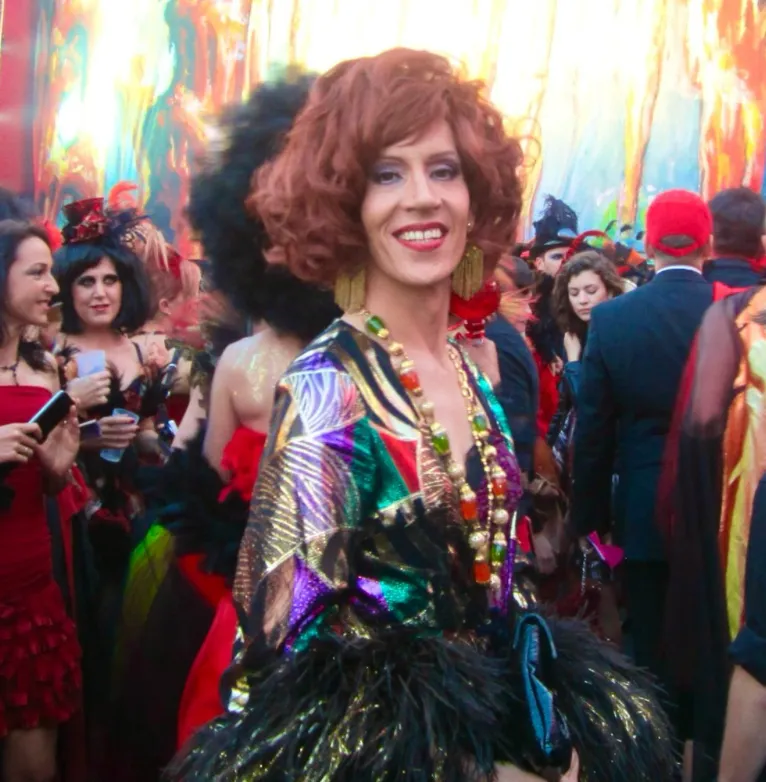
NYC's Queer Legacy with Archivist and Historian Linda Simpson
let’s start with an easy one: is there any song or artist which you love to listen to while getting ready for a night out?
has the new-found popularity of drag within media (drag race, but also boulet brothers and the popularity of drag on platforms like instagram and tiktok) changed how you approach documenting drag and queer nightlife at all?
are there parts of queer nightlife/drag culture which you feel are underrepresented (or overrepresented), for better or for worse?
how have you managed existing within and navigating between both the art/gallery world and the nightlife/party world?
many of the iconic clubs of the 80s and 90s are no longer around- are there clubs/parties which you feel embody the spirit of the heyday of the club kid? what were/are your favorite parties to photograph?
who to you are the club kids of today? who are you always excited to see/photograph when going out on the scene?
where there any cinematic representations (i.e. the queen, paris is burning, to wong foo, etc.) which you felt had an impact on you beginning to photograph queer nightlife?
much of your earlier work, such as your iconic and beautiful photographs of Page, existed and first circulated in a time where paper ephemera, zines, and print culture played a much bigger role within NYC nightlife than they do today. what, if any, do you think is the importance of preserving these information forms within our communities? are there any current projects (i.e. dykes and dolls, hivemind books, howl arts, american girl doll, interference archive, etc.) which you feel are continuing this legacy today?
one of your most iconic pieces of work is your underground zine My Comrade, from the late 1980s- early 90s, the first issue of which has you posing in the infamous photo of Patty Hearst. Do you think drag is inherently political? what, if any, do you see as the relationship between drag and politics, whether fringe or mainstream?
ANSWERS
1. let’s start with an easy one: is there any song or artist which
you love to listen to while getting ready for a night out?
I mostly listen to political programs on YouTube. I’m a bit of a news
junkie. For music, I prefer playlists I’ve made of various songs,
often with a heavy dose of disco.
2. has the new-found popularity of drag within media (drag race, but
also boulet brothers and the popularity of drag on platforms like
instagram and tiktok) changed how you approach documenting drag
and queer nightlife at all?
I notice that the most engagement I get on social media is when I post
photos I took of NYC’s drag scene in the 1980s and ‘90s. So while
everyone else is chasing the new, I’m focusing on nights gone by!
3. are there parts of queer nightlife/drag culture which you feel
are underrepresented (or overrepresented), for better or for
worse?
Well, honestly, I’m not sure if every gay bar and club needs to
feature drag shows. Sometimes you just want to go in for a drink and a
chat rather than having to pay attention to a lipsynch.
4. how have you managed existing within and navigating between both
the art/gallery world and the nightlife/party world?
I guess it’s been kind of a progression. My younger years were spent
partying at the clubs. And now I’ve dipped my toe into the art world,
which is more of a daytime affair.
5. many of the iconic clubs of the 80s and 90s are no longer around-
are there clubs/parties which you feel embody the spirit of the
heyday of the club kid? what were/are your favorite parties to
photograph?
I’ve been to Queer Nightlife Community Center (QNCC) a few times in
Brooklyn. It’s a former industrial space and I’m really impressed by
the scale of it. The largeness reminds me of the big clubs back in the
day, like Palladium, The Tunnel, Roxy, the Limelight and others. Back
in the 1980s and ‘90s, I took photos all over as I roamed the
nightlife. But nowadays, my photo-taking is a lot more limited because
I don’t go out nearly as much.
6. who to you are the club kids of today? who are you always excited
to see/photograph when going out on the scene?
I’m always excited to see my old-school friends when I’m out and
about. A reminder that we’re still alive!
7. where there any cinematic representations (i.e. the queen, paris
is burning, to wong foo, etc.) which you felt had an impact on
you beginning to photograph queer nightlife?
I was very intrigued by Andy Warhol’s social scene of the 1960s and
‘70s, including his drag and trans superstars, like Jackie Curtis,
Candy Darling and Holly Woodlawn. I wanted to be around exciting
people like them.
8. much of your earlier work, such as your iconic and beautiful
photographs of Page, existed and first circulated in a time where
paper ephemera, zines, and print culture played a much bigger
role within NYC nightlife than they do today. what, if any, do
you think is the importance of preserving these information forms
within our communities? are there any current projects (i.e.
dykes and dolls, hivemind books, howl arts, american girl doll,
interference archive, etc.) which you feel are continuing this
legacy today?
I’m all for preserving and celebrating print media that came before
us. I think for gay people especially it played such an important way
of communicating with each other. Honor our history! I follow some
Instagram pages that often include images from bygone gay magazines.
Always fun to see.
9. one of your most iconic pieces of work is your underground zine
My Comrade, from the late 1980s- early 90s, the first issue of
which has you posing in the infamous photo of Patty Hearst. Do
you think drag is inherently political? what, if any, do you see
as the relationship between drag and politics, whether fringe or
mainstream?
It’s actually the drag queen Tabboo! posing as Patty Hearst. (I’m
much prettier!) I think drag is always going to be somewhat
political, just because it riles up conservations so much. They
get triggerd so easily and then try to legislate drag. Dumb and
annoying. But for the most part, I think drag is mostly about
having some good ol’ fun!